

Why Is Power Density Becoming Important for RF Exposure Assessment Above 6 GHz?
- Published: 2026-10-08
How RF Exposure Assessment Criteria Are Changing with the Transition to 5G and 6G
In 5G-Advanced and future 6G mobile communication environments, the use of higher frequency bands and technologies such as array antennas and beamforming is expanding. These changes are not only increasing communication speeds and data throughput but are also changing how human exposure to RF electromagnetic fields generated by wireless devices is assessed.
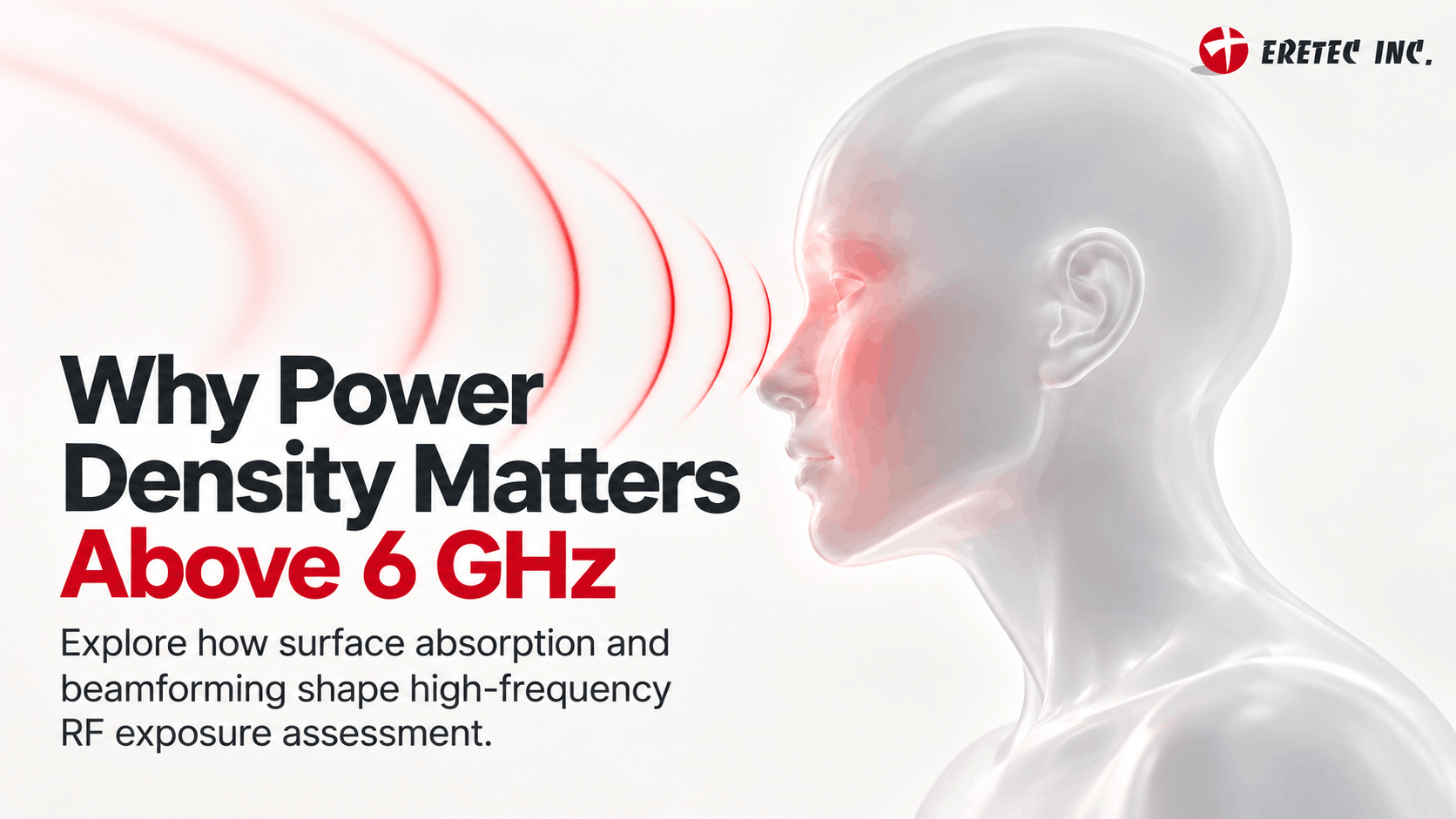
RF exposure assessment for portable wireless devices has long centered on SAR (Specific Absorption Rate). However, in high-frequency ranges above 6 GHz, RF energy tends to be concentrated near the skin and body surface rather than penetrating deeply into human tissue. Accordingly, along with conventional SAR, Power Density, which evaluates power per unit area, is being used as an important exposure metric.
This change does not mean that SAR is no longer necessary. What matters is selecting the appropriate exposure metric according to the frequency, product type, and applicable regulations, and accurately understanding the physical meaning and measurement method of each metric.
What Does SAR Measure?
RF Power Absorbed by Human Tissue per Unit Mass
SAR is a metric that represents the RF power absorbed per unit mass by human tissue exposed to RF electromagnetic fields, and its unit is W/kg. It has long been used to assess RF exposure compliance for wireless devices used close to the head or body, such as mobile phones.
IEC/IEEE 62209-1528:2020, a representative international standard, covers SAR measurement procedures for wireless communication devices used close to the head or body over the frequency range of 4 MHz to 10 GHz. In testing, a phantom that simulates the electrical properties of human tissue and a measurement system are used to evaluate how much RF energy is absorbed by the tissue.
The fundamental question addressed by SAR can therefore be summarized as follows:
"How much RF power does human tissue absorb for a given mass?"
This approach has played an important role in assessing human exposure in frequency ranges where RF energy penetrates into tissue to a certain depth.
Why Does the Assessment Perspective Change Above 6 GHz?
As Frequency Increases, RF Energy Absorption Moves Closer to the Body Surface
As frequency increases, wavelength becomes shorter, and the penetration depth of RF energy into human tissue decreases. Particularly in high-frequency ranges above 6 GHz, the concentration of RF energy absorption near the skin and body surface becomes increasingly important.
In such environments, rather than relying solely on SAR, which evaluates absorbed power on a per-unit-mass basis, Power Density metrics that assess energy flow or absorption per unit area become important for describing high-frequency exposure characteristics.
In other words, the assessment perspective expands from how much power is absorbed by a given mass of tissue to include how much power is incident on or absorbed over a given area.
For this reason, understanding Power Density is important in RF exposure assessment for high-frequency wireless systems such as 5G NR FR2.
SAR vs. Power Density: What Is the Difference?
Absorbed Power per Unit Mass vs. Power per Unit Area
The most fundamental difference between SAR and Power Density lies in the basis of assessment.
SAR evaluates RF power absorbed by human tissue on a per-unit-mass basis. Power Density, on the other hand, evaluates power flow or absorption on a per-unit-area basis.
Therefore, the two metrics should not simply be understood as an old metric and a new metric. The appropriate exposure metric varies depending on the product frequency, conditions of use, applicable exposure limits, and test standards.
IEC/IEEE 62209-1528:2020 specifies SAR measurement procedures for portable and body-mounted wireless devices over the frequency range of 4 MHz to 10 GHz. For Power Density assessment of high-frequency wireless devices used in close proximity to the body, the IEC/IEEE 63195 series serves as an important set of international standards. IEC/IEEE 63195-1:2022 covers Power Density measurement procedures from 6 GHz to 300 GHz, while IEC/IEEE 63195-2:2022 covers assessment procedures based on computational methods over the same frequency range.
Therefore, in Human Exposure Assessment for the 5G and 6G era, rather than treating the question as a simple choice between SAR or Power Density, it is necessary to first determine which exposure metric and assessment method apply according to the product, frequency, and regulatory requirements.
Power Density Is Not a Single Concept
The Difference Between Incident Power Density and Absorbed Power Density
When understanding Power Density, it is particularly important to distinguish between Incident Power Density (IPD) and Absorbed Power Density (APD).
Incident Power Density is an external exposure metric that represents the energy flow of an electromagnetic field incident on the human body or an evaluation surface per unit area. Absorbed Power Density, on the other hand, is an internal exposure metric that represents the power absorbed into tissue through the body surface per unit area.
Although both concepts are based on unit area, they represent physically different quantities. One addresses the energy flow of the electromagnetic field reaching the human body, while the other addresses the power actually absorbed by the tissue.
Therefore, when planning a Power Density test, it is necessary to distinguish which type of Power Density is being evaluated and which exposure limit and assessment method apply, rather than simply defining the test as measuring Power Density.
This distinction may become even more important when developing test plans for 5G NR FR2 and future high-frequency wireless devices.
If You Want to Explore Power Density Test Systems in Greater Detail
Once you understand why exposure metrics change above 6 GHz, the next step is determining how to measure Power Density accurately and repeatably in practice.
Probe characteristics, scanner spatial resolution, the distance between the DUT and Evaluation Surface, positioning accuracy, spatial averaging, chamber reflections, and measurement uncertainty can all affect the results.
ERETEC’s white paper, Power Density Measurement Technology for RF Human Exposure Assessment in the 5G and 6G Era, explains in detail how these elements can be connected as a single Measurement Chain to build an infrastructure for high-frequency RF exposure assessment.
How Do IEC/IEEE 62209-1528 and IEC/IEEE 63195 Differ?
Test Standards Also Vary According to Frequency and Assessment Method
To understand high-frequency RF exposure testing, it is necessary to distinguish not only between exposure metrics but also between the scopes of the relevant international standards.
IEC/IEEE 62209-1528:2020 specifies SAR measurement methods for portable and body-mounted wireless devices used close to the head or body over the frequency range of 4 MHz to 10 GHz. It provides a testing framework for SAR Compliance Assessment, including human body models, measurement systems, and measurement procedures.
IEC/IEEE 63195-1:2022 covers Power Density measurement procedures for wireless devices used close to the head or body over the frequency range of 6 GHz to 300 GHz. The measurement framework includes probes, scanning systems, measurement instrumentation, spatial averaging, system validation, and measurement uncertainty.
IEC/IEEE 63195-2:2022 covers procedures for assessing Power Density through computational methods over the same frequency range of 6 GHz to 300 GHz.
Therefore, rather than simplifying the 6 GHz boundary as the point at which one test immediately changes into another, it is more accurate to consider the product, frequency range, regulatory requirements, and applicable assessment procedures together.
Why Does Beamforming Make Power Density Measurement More Difficult?
Checking Maximum Output Alone May Not Be Enough to Identify the Maximum Exposure Condition
Another important change in high-frequency RF exposure assessment concerns the antenna architecture and operating method of the DUT (Device Under Test).
In high-frequency systems such as 5G NR FR2, beamforming may be used to concentrate RF energy in a specific direction by arranging multiple antenna elements and controlling the phase and amplitude of each element.
In these systems, there is not necessarily a single fixed radiation pattern. Depending on the beam configuration, the spatial distribution of the electromagnetic field and the location of its maximum value can change.
As a result, in Power Density measurement, simply setting the DUT to maximum output may not always ensure that the maximum exposure condition has been established. Frequency, antenna configuration, beam direction, operating mode, output condition, and DUT orientation may all need to be considered together.
When the distance between the DUT and Evaluation Surface, probe position, scan area, and grid resolution are added to these variables, the test conditions become even more complex.
Particularly in the near field, even small changes in position can alter the electromagnetic field distribution. Therefore, a positioning system capable of accurately reproducing the relative position between the DUT and probe, along with a scanner providing sufficient spatial resolution, is important.
Power Density Measurement Does Not End with a Single Probe
Accuracy Is Determined by the Entire Measurement Chain
Probe performance is extremely important in high-frequency Power Density assessment. However, having an accurate probe alone does not automatically ensure the accuracy and repeatability of test results.
Actual test results can be affected by various factors, including probe calibration and spatial resolution, scanner position accuracy, DUT alignment, evaluation distance, sampling, spatial averaging, laboratory reflections, and DUT output drift.
Therefore, in high-frequency Power Density testing, how the entire Measurement Chain is configured and managed is more important than the performance of any individual piece of equipment.
External RF interference and unwanted reflections must be controlled in the test environment, while the probe and scanner must measure the field distribution with the required spatial resolution. The relative position between the DUT and Evaluation Surface must also be reproducible, and the acquired data must undergo spatial averaging and maximum finding according to the applicable criteria.
Calibration, System Check, System Validation, and measurement uncertainty management must also be integrated into this process to ensure the reliability and traceability of actual test results.
Changes in Exposure Metrics Lead to Changes in Test Infrastructure
Why 5G and 6G RF Exposure Assessment Should Be Viewed as an Integrated System
The growing importance of Power Density in high-frequency environments above 6 GHz does not simply mean that one new measurement item is being added.
When the exposure metric changes, the physical quantities and spatial regions to be measured, the required performance of probes and scanners, DUT positioning, data processing methods, and system validation methods may all change accordingly.
Particularly for high-frequency DUTs using array antennas and beamforming, multiple beams and operating conditions may need to be evaluated repeatedly. If the scanner and positioner, DUT control, RF instrumentation, data acquisition, and analysis are operated separately, test time may increase and dependence on the test operator may also become greater.
Therefore, future test environments for high-frequency RF exposure compliance need to be approached from the perspective of an integrated Measurement Infrastructure rather than as a collection of individual measurement instruments.
RF Test Environment → Measurement System → Positioning → DUT/Beam Control → Data Acquisition → Power Density Analysis → Calibration & System Validation → Reporting
This structure can provide a foundation not only for current 5G NR FR2 testing but also for responding to future changes in frequency, antenna architecture, and assessment requirements.
From SAR to Power Density, What Matters Is the Entire Assessment Framework
RF human exposure assessment in the 5G and 6G era is not simply a process of replacing SAR with Power Density. The key is to select the appropriate exposure metric according to the product frequency, conditions of use, applicable regulations, and test standards, and to establish a measurement environment capable of evaluating that metric reliably.
In high-frequency ranges above 6 GHz, Power Density-based assessment becomes important because of the RF energy absorption characteristics near the body surface. As beamforming and complex antenna configurations are added, the need to consider probes, scanners, positioning, the RF environment, data analysis, and system validation together also increases.
Ultimately, competitiveness in high-frequency RF exposure assessment depends not on the specification of a single measurement instrument, but on how accurately test conditions can be implemented and how consistently the same conditions can be reproduced.
If You Need a Strategy for Building 5G and 6G Power Density Test Infrastructure
ERETEC’s white paper, Power Density Measurement Technology for RF Human Exposure Assessment in the 5G and 6G Era, provides an in-depth overview of integrated test infrastructure strategies based on IEC/IEEE 63195, covering key challenges in Power Density measurement, probe, scanner, and positioner configurations, measurement uncertainty, system validation, test automation, and data management.
Explore how to move beyond individual Power Density measurement equipment and build a high-frequency RF exposure assessment environment with the accuracy and repeatability required for reliable testing.